Lead Follow Up: How Fast Should You Reply to a New Enquiry?
Lead follow up decides whether an enquiry becomes booked work. Here is how fast to reply, what to say and how an AI CRM can do it for you.
Innovision Code Team 9 min read
Every service business in Ontario knows the feeling. You finish a job, check your phone and find three new enquiries waiting. Good lead follow up is what turns those messages into booked work, and it comes down to three things: being quick, being friendly and being consistent. The difficulty is that busy days, site visits and evening enquiries make all three hard to manage by hand.
This guide is written for plumbers, clinics, contractors, agents, studios and every other owner who answers their own enquiries. It explains how fast to reply, what to say, how to follow up without being pushy and how an AI CRM can handle the routine parts so that you can focus on the work and the people in front of you.
In this guide
Why lead follow up matters
A new enquiry is a small moment of trust. Someone has looked at your website, your listing or a recommendation, decided you might be able to help and taken the time to write. They have not hired you yet. They are usually comparing a few businesses, and they are often sending the same message to more than one of them.
In that moment, the business that answers clearly and kindly gives itself a real head start. A warm reply says that you are reliable, that you listen and that working with you will be easy. A silence of several hours, or several days, says the opposite, even when the work you do is excellent. That is why lead follow up deserves a little structure, even in a small team.
There is also a simple practical reason. You have already paid, in time or in advertising, to earn that enquiry. Replying well is the cheapest part of the whole process, and it is the part most likely to be skipped when the day gets busy.
How fast should you reply?
There is no single magic number, and we would be wary of anyone who offers one without a source. A better way to think about it is in three levels.
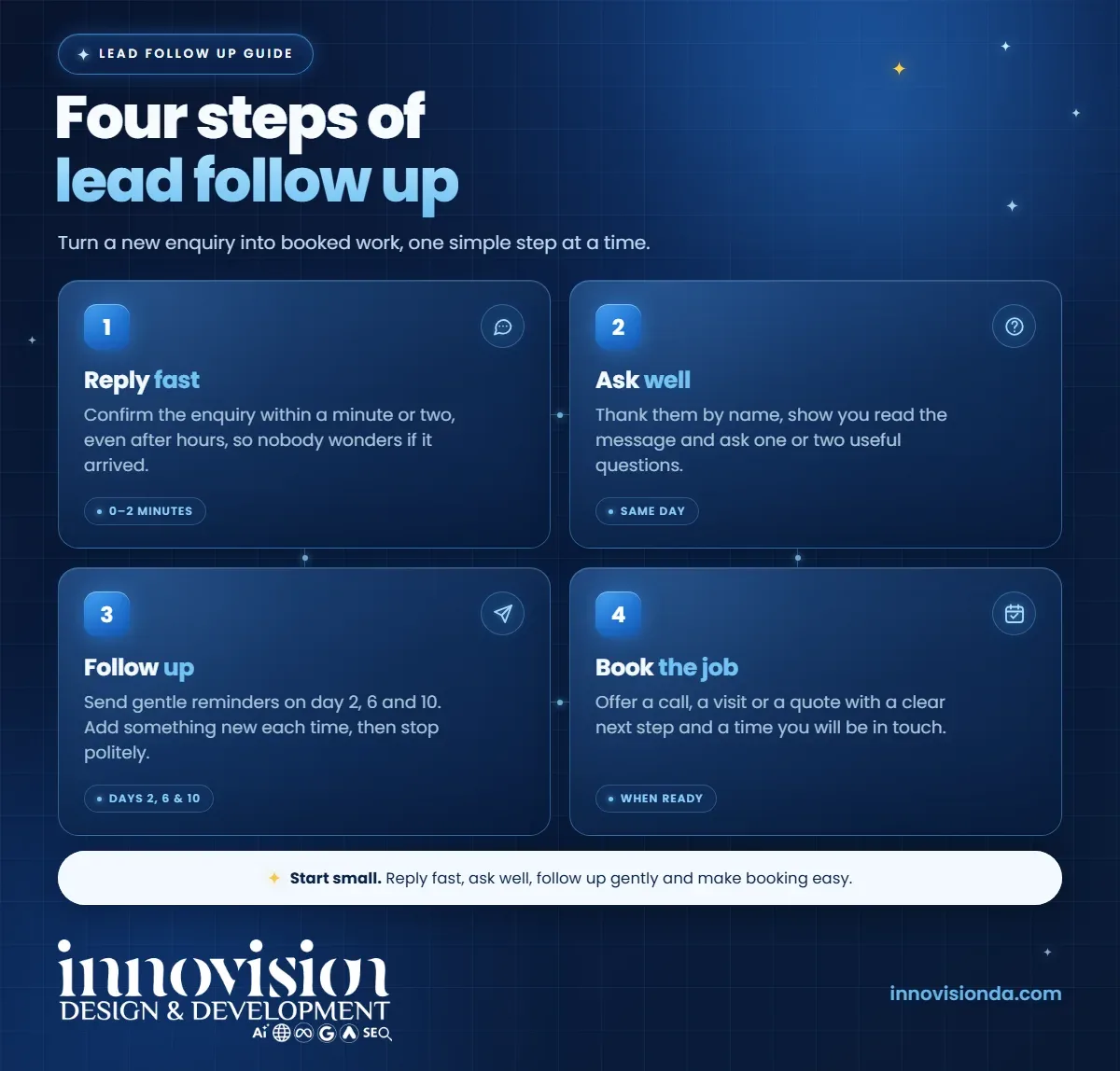
Immediately. Within a minute or two, the person should see that their message arrived. This can be a simple automatic confirmation that says who you are, that you received the enquiry and when they can expect a personal reply. It removes the uncertainty of wondering whether the form worked.
Within the working day. A real, personal reply from you or your team, ideally within a few hours during business hours, is a sensible goal for most service businesses. Many owners find that a short window in the morning and another after lunch is enough to stay ahead.
By the next morning at the latest. Enquiries that arrive in the evening or on a weekend should have a reply waiting at the start of the next working day, and an automatic message in the meantime.
If you can only improve one thing about your lead follow up this month, make the first level automatic. A fast confirmation costs you nothing once it is set up, and it keeps the conversation warm while you finish your job.
What to say in your first reply
A good first reply is short, human and useful. It does not need to sell. It needs to make the next step easy. Most strong replies include the same five parts.
A greeting by name. Use the name the person gave you.
A thank you. One sentence is enough.
A sign that you read the message. Mention the service or the problem they described, because that is what makes lead follow up feel personal.
One or two questions. Ask only what you need to give a useful answer, such as the address, the preferred date or the size of the job.
A clear next step. Offer a call, a visit or a quote, and say when you will be in touch.
Here is an example for a home service business: "Hello Maria, thank you for contacting us about your leaking kitchen tap. We would be glad to help. Could you tell us your postal code and whether the leak is constant or only when the tap is on? I will call you this afternoon between 2 and 4 pm to arrange a visit."
Notice what is missing: no long list of services, no pressure and no jargon. The goal is a reply that feels like it came from a real person who is happy to help, because it did.
A simple lead follow up schedule
Many enquiries do not turn into a conversation on the first message. People get busy, they compare options or they simply forget. A gentle schedule keeps you in mind without becoming a nuisance. Here is one that works well for many service businesses, and you can adjust the timing to suit yours.
Minute one: an automatic confirmation that the enquiry arrived.
Same working day: your personal reply with a question and a next step.
Day two or three: a friendly check in if there has been no answer. Offer something helpful, such as a time slot or a short answer to a common question.
Day six or seven: a second, different message. Share a relevant example of your work or a useful tip.
Day ten: a polite last note that says you are happy to help whenever the timing is right, and then stop.
Each message should add something new rather than repeat the last one. Stopping politely after the final note is part of good lead follow up. It respects the person, and it protects your reputation.
Where lead follow up usually breaks down
The same few problems tend to come up again and again. None of them are about effort. They are about having too many things to do at once.
Enquiries arrive in too many places. A website form, a phone message, a social media message and an email can all land in different inboxes.
Nobody owns the reply. Everyone assumes someone else has answered.
Follow ups depend on memory. The first reply goes out, then the day gets busy and the second message never happens.
There is no record. Without a simple list of who asked, when and what happened next, it is hard to see which conversations are still open.
Evenings and weekends are quiet. The enquiry arrives at 9 pm, and the reply goes out two days later.
If two or three of these sound familiar, you are in good company. They are exactly the gaps that a simple system is designed to close.
How an AI CRM handles lead follow up
A CRM is simply a tidy place where every enquiry lives. An AI CRM adds a layer of automation on top, so that the routine steps happen without anyone having to remember them. For lead follow up, that usually means five things.
Every enquiry is captured in one place, whether it came from your website, a form or a message.
An instant reply goes out, day or night, confirming the message and setting expectations.
Follow ups are sent on schedule, using wording you have approved, until the person books or says no.
Every lead has a status, so you can see at a glance who is new, who has been contacted and who is booked.
You receive a short summary, so nothing slips through the cracks.
The important point is that you stay in control. You decide the wording, the timing and when to step in personally. The automation handles the repeat work, and you handle the conversations that need a human voice.
Prices and packages change from time to time, so we do not quote numbers in our articles. The current details, together with what each package includes, are always on our pricing page, so you can check them whenever you like and compare them with any other offer you receive.
If you would like a deeper look at what a CRM can and cannot do, our guide to an AI CRM for small business in Canada is a good next read, and our overview of AI automation shows how the same idea applies to other repeat tasks.
A short note on consent and email
Automatic follow up emails are commercial electronic messages, and Canada has rules about them. The Government of Canada explains that its anti spam law has led businesses to request, among other things, that they obtain consent before sending commercial electronic messages. You can read the official overview on the Government of Canada anti spam legislation page.
We are not lawyers, and that page is a general overview rather than legal advice, so please check your own situation with a qualified professional. In practice, the habits that serve you well are simple: send follow ups to people who have contacted you, say clearly who you are, make it easy to opt out and stop when someone asks.
Your next step
You do not need to rebuild your business to improve your lead follow up. Start small. This week, write down where your enquiries arrive, set up a fast confirmation message and draft a short three step follow up sequence. Then watch how many conversations stay open instead of fading away.
If you would like a friendly second opinion, our free website analysis shows how your website handles enquiries today, including how visible your contact options are and whether anything appears to be missing. You can also ask for a free growth plan from our pricing page, and we will reply within 2 business days with practical next steps and an exact quote, with no obligation.
Frequently asked questions
How quickly should I reply to a new enquiry?
Confirm receipt within a minute or two, ideally with an automatic message, and send a personal reply within the working day. Enquiries that arrive in the evening should have a reply waiting the next morning.
What should a first reply include?
A greeting by name, a thank you, a sign that you read the message, one or two useful questions and a clear next step with a time. Keep it short and human.
How many times should I follow up with a lead?
A gentle sequence of three to four messages over about ten days works well for many service businesses. Make each message add something new, and stop politely after the last one.
Can an AI CRM reply for me?
Yes. An AI CRM can send an instant confirmation, follow up on a schedule you approve and show you the status of every lead. You decide the wording and when to step in personally.
Do I need consent to send automatic follow up emails in Canada?
Canada has rules about commercial electronic messages, including consent. Please read the official guidance and check with a qualified professional about your own situation.