Do you need a website in 2026? A guide for local businesses
An honest answer for local businesses: do you need a website if you run on word of mouth? What a website gives you, what it cannot do and what a first one needs.
Innovision Code Team 9 min read
Many good local businesses do very well without a website. They have loyal customers, a busy social media page and a Google listing, and they wonder whether a website is still worth the effort in 2026. So, do you need a website? It is a fair question, and it deserves an honest answer, not a sales pitch.
The short answer to the question, do you need a website, is yes for most local businesses, because a website is the one place online that you own and control. But it does not need to be big, expensive or complicated. This guide explains why, what a website can and cannot do, and what a first version really needs.
In this guide
- How customers find a local business today
- Do you need a website when you already have social pages?
- What a website gives you
- What a first website needs
- It must work well on a phone
- How AI search changes things
- What a website cannot do by itself
- Do you need a website if customers all come by word of mouth?
- When a website may not be your first step
- A simple plan
- Where to go next
How customers find a local business today
When someone needs a service nearby, they usually follow a short path. They search on Google or in a maps app, look at a few results, check reviews and photos, and then contact the business that feels clear and trustworthy. Increasingly, they also ask an AI assistant for a recommendation. At each of these steps, the business that provides clear and accurate information has an advantage.
The question, do you need a website, often comes down to this path. If your business is easy to find and easy to understand, you are more likely to be chosen. If a customer cannot find your hours, your services or a simple way to reach you, they often move on without telling you.
Do you need a website when you already have social pages?
A Google Business Profile and social media pages are valuable, and you should keep them. A complete Google listing helps you appear in local searches and on maps. Social pages let you share photos, news and offers, and they let customers see that you are active.
But they have limits:
- You do not own them. The platform sets the rules, the layout and what people see. Those rules can change.
- They have little room for detail. A page of services, prices, a clear booking route and answers to common questions rarely fits well in a social feed.
- They are not built for every search. Many people prefer to read a proper page before they decide.
- Your story is scattered. Information lives in several places, and it is easy for it to become out of date in one of them.
What a website gives you
So, do you need a website? Think about what it gives you. A website is your home on the internet. It brings your information together in one place that you control.
- Trust. A clear website tells customers that you are real, established and easy to reach.
- Clarity. You explain what you do, where you work, and how to contact you, in your own words.
- A way to take action. A phone button, a request form or a booking link turns interest into a conversation.
- Search visibility. Clear pages give search engines and AI assistants something accurate to understand and recommend.
- A base for everything else. Your social posts, ads and email can all point to one place that you own.
What a first website needs
A first website does not need twenty pages. It needs to answer the questions a new customer has, quickly, on a phone. Here is a checklist for the first page.
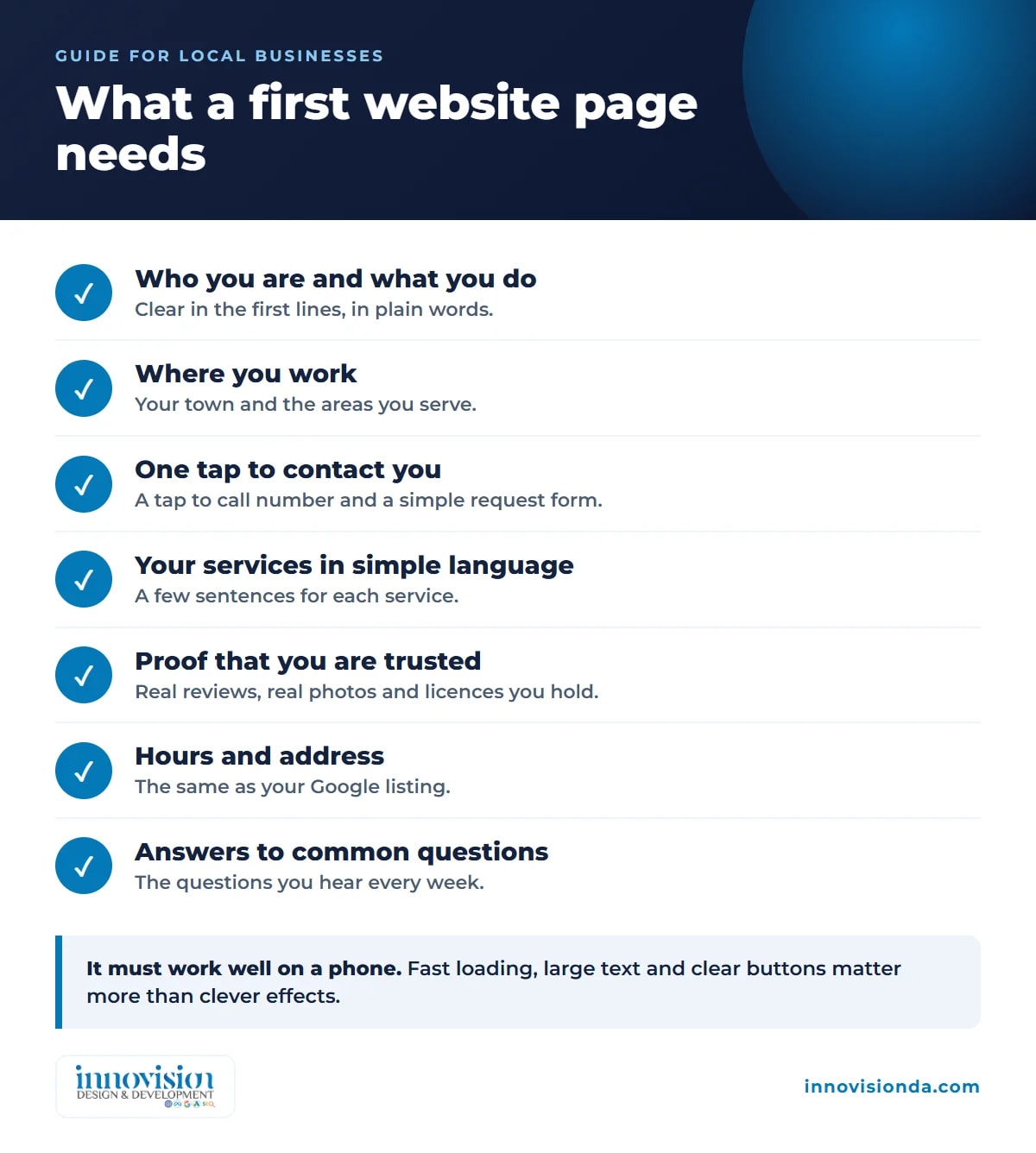
1. Who you are and what you do
Say it in the first lines, in plain words. A visitor should know within a few seconds what you offer and who you serve.
2. Where you work
Name your town and the areas you serve. This helps customers and helps local search.
3. A way to contact you in one tap
A phone number that can be tapped to call, and a simple request form, are the two most useful things on a local website.
4. Your services in simple language
List what you offer and describe each one in a few sentences.
5. Proof that you are trusted
Show real reviews, real photos and any licences or memberships you hold.
6. Hours and address
Keep these the same as your Google listing, so customers see one story.
7. Answers to common questions
A short list of questions you hear every week helps customers and helps AI assistants understand your business.
It must work well on a phone
Most local searches happen on a phone, so your website should load quickly and be easy to use with a thumb. Large text, clear buttons and a simple layout matter more than clever effects. A slow or cluttered site can lose visitors before they read a word.
How AI search changes things
People now ask AI assistants questions such as which company is a good choice for a particular job near them. These tools read the information available online, and a clear website is one of the best sources you can provide. Clear text about your services, your area and your contact details helps an AI assistant describe you correctly. The same clear pages also help ordinary Google searches, so one simple website supports both.
What a website cannot do by itself
A website does not bring customers just because it exists. It needs to be easy to find, clear to read and kept up to date. It also needs a way to turn interest into action: a quick reply to every enquiry, a follow up when someone asks for a price, and a simple way to ask happy customers for a review. The people and the process behind it still make the difference, and this is where a little AI automation can help a small team keep up.
Local businesses in every trade face the same gap. Our guide to AI for dental clinics shows how a quick, friendly reply works for patients, and our guide to AI automation for HVAC and home service businesses shows the same idea for quotes and bookings.
Do you need a website if customers all come by word of mouth?
Often the answer is still yes, and these common myths show why:
- "My customers all come by word of mouth." Word of mouth often ends with a search. Someone hears your name and then looks you up before calling.
- "A website is too expensive." A small, clear website is a different thing from a large custom project. Start with what you need.
- "Social media is enough." It is useful, but it is not a place you own.
- "I will do it later." The best time is when you are not in a rush, because a rushed website is rarely a good one.
When a website may not be your first step
If you are only starting and have no services or contact details settled yet, a complete Google Business Profile and one social page may be enough for now. If your business is fully booked by a small group of long term clients and you do not want new customers, a website is less urgent. So, do you need a website right now? For almost everyone else, a simple website is a sensible step.
A simple plan
If your answer to do you need a website is yes, here is a plan you can follow at your own pace.
- Complete your Google Business Profile with correct hours, photos and services.
- Write down your services, your area and your contact details in plain language.
- Collect photos and reviews that you have permission to use.
- Build a clear first version with the seven items above, and make sure it works on a phone.
- Add to it over time with new pages, answers to questions and articles, as your business grows.
The Ontario government also keeps a small business page that links to funding programs, advisors and other resources, which is a useful place to look as you plan.
At Innovision Design & Development, our website design and development service is built around exactly this: a clear, fast website that your customers can use on a phone. Once the website is in place, AI automation can answer new enquiries quickly and follow up for you, so the website does more than sit there.
Where to go next
For a wider picture of what technology can do for a small business, read our practical guide to AI automation for small business in Canada. Still asking do you need a website? When you are ready to talk, request your free growth plan. Tell us about your business, and we will suggest practical next steps that fit it.
Frequently asked questions
Do you need a website if you already have social media pages?
For most local businesses a simple website is worth having. Social pages are useful, but you do not own them and they offer little room for detail. A website brings your services, area, contact details and proof together in one place you control.
Is a Google Business Profile enough?
It is an important start and you should keep it complete. It cannot hold everything, though. A website lets you explain your services, answer common questions and give customers a clear way to contact you.
How big does my first website need to be?
Small. A clear first page with who you are, where you work, a one tap way to contact you, your services, proof, hours and a few answers to common questions is a good start. You can add pages later.
Does my website need to work on a phone?
Yes. Many local searches happen on a phone. Your site should load quickly, have large readable text and clear buttons, and make calling or sending a request easy.
How does a website help with AI assistants and search?
Search engines and AI assistants read the information available online. A clear website with accurate details about your services, area and contact information helps them understand and describe your business correctly.
What should I do first?
Complete your Google Business Profile, write down your services and contact details, and request a free growth plan. We will suggest practical next steps that fit your business.